Showing posts with label Dancing. Show all posts

Friday, November 23, 2007

The Dervish Hordes of Omdurman


The drums beat louder and louder, the intoxicating rhythmn quickening. The setting sun casts a golden light across the scene, and the unmistakable aroma of marijuana drifts through the dusk air. A brightly-dressed man in yellow robes marches gaily around the edge of the circle wafting clouds of incense from a brazier swinging aily by his side. Hundreds of voices cry out in unison, singing the first line of the shahada, the Muslim declaration of faith, "la illaha ila-llah, la illaha ila-llah, la illaha ila-llah, la illaha ila-llah". There is no god but Allah, there is no god but Allah. Everyone dances wildly, limbs flailing, heads thrown back, dreadlocks swinging. The chanting continues incessantly, "la illaha ila-llah, la illaha ila-llah". Even my feet are twitching now, as everyone in the crowd begins to sway in time to the music. A man breaks out of the circle and dances into the centre. Suddenly he is up on one leg, spinning manically, all the while chanting. "la illaha ila-llah, la illaha ila-llah". All around me, other dervishes break out of the circle and begin to spin around, chanting, always chanting, lost on their personal path to God.

This is about as far away from most people's image of Islam as it's possible to get, more Woodstock than Wahabi, in many ways closer to an ecstasy-fuelled Shoreditch rave than a veneration of Allah in one of the world's most strictly Muslim countries. Yet Islam it is, and hardly could there be a better example of Sudan's perplexingly contradictory attitude to religion than the Whirling Dervishes.

As has become well-known in the West, and particularly in the UK, in the last few days, Sudan is officially an Islamic republic, with Islamic Sharia - "street" - Law in operation, at least in the Arab north of the country. Indeed, prior to his now infamous sojurn in Taliban-controlled Afganistan, a certain well-known Saudi construction magnate and outspoken religious cleric spent five years resident in Sudan in the mid-1990s, departing only after intense American pressure forced the Khartoum government to expel him. From what I can discern, Sheikh bin Laden is a hero to the majority of Sudanese, as much for his unpublicised (in the West) philanthropy as his better known slaying of infidels. Most of the tarmac highways in Sudan (of which there are not many) were financed and built by Osama and his construction firm, as was the Port Sudan International Airport.

Yet perversely, bin Laden's strict Saudi Wahabi interpretation of Islam would be anathema to the Sudanese, who tend towards the much more laidback, mystical, Sufi strain of the religion, and incorporate many traditional tribal beliefs and practises into their faith. Such "un-Islamic" ideas as witchdoctors, exorcisms, and saints are apparently common in Sudanese Islam, while women openly converse or shake hands with unknown men (including strange white men with backpacks) without apparent fear of reprisal. Amazingly many Sudanese love having their picture taken, and unsolicited offers of pictures to unwary travellers are common. Local children in particular are often openly enraged at polite refusals - unable to believe that a khawaja (an affectionate term roughly equivalent to the Spanish "gringo" or the Thai "farang") could possibly ever venture outside without a camera. Most perversely of all, at least in the eyes of orthodox Islam, the Sudanese are apparently rather partial to alcohol, and despite the strict ban on the importation and sale of booze, homemade moonshine is apparently a big hit with locals, particularly in rural areas. (Suffice to say I have not tried it myself - a Spanish traveller I met who had, assured me that he was lucky to escape with his life. He was talking about the hangover, but the consequences of being caught don't really bare thinking about. Being arrested once in Sudan was careless, twice would surely be foolish.)

But as the unfortunate Gillian Gibbons and her teddy bear "Mo Mo" have found out this week, despite all the eccentricities of Sudanese Islam, it is after all a very important part of life here. Perhaps more so than any other Muslim country I have visited, Islam is a very public facet of Sudanese society. Walk along any street or sit in any hotel at one of the five allotted prayer times each day and there are countless hundreds of Sudanese, uniformly clad in their mostly immaculate white robes and skullcaps, kneeling on a mat or carpet in supplication to Allah, quietly muttering the shahada to themselves. This can pose a few logistical problems for the unbeliever, as it is supposedly considered very bad form to walk in front of a praying Muslim. No problem when said devotee is kneeling on the pavement of a wide street, but it is a different story when he is blocking the door of your hotel room, from which you need to exit at some speed in order to reach the bathroom down the corridor to deal with what you fear may in fact be a new and virulent strain of cholera. Allah apparently took pity on my pathetic state and has, as yet, neglected to smite me for the rather ungainly manner in which I hurdled two of his faithful on my way to the disgusting hole in the ground which doubles for a bathroom in the "Namarg" Hotel in Wad Medani earlier this week. Happily his mercy has also extended to granting me a reprieve from the more unpleasant symptoms of my mysterious stomach ailment. Allahu Akbar!

As I watched the dervishes twirling and whirling, my thoughts drifted back through time, and came to rest in roughly the same location a century or so earlier, with the brave men of the British Army who faced down a force of some forty thousand "dervish" devotees of the Sudanese Caliphate at the infamous Battle of Omdurman in 1898. Despite their vastly superior numbers, and their absolutely fervent belief in the power of Allah to bring victory, the dervish army were massacred in their thousands by the well-trained and crucially well-equipped forces. The Sudanese were a formidable foe: 15 years previously their fearless infantry charges had defeated the British and allowed the Mahdi - the self-appointed Islamic Messiah - to expel the anglo-Egyptian rulers of Sudan and famously to murder the Governor General, Charles "Chinese" Gordon in Khartoum. So impressed was Rudyard Kipling by the heroism of the Sudanese warrior-mystics, he eulogised them in his poem "Fuzzie Wuzzy". His admiring description, "You're a pore benighted 'eathen but a first-class fightin' man" might appear grimly familiar to modern British soldiers fighting Muslim foes in Afghanistan and Iraq.

After the performance had finished, I was approached by an array of curious locals, with whom I sat and drank tea. Some were Arab Muslims, some were not (the ethnically African south of Sudan is overwhelmingly Christian and/or Animist in its beliefs), but inevitably given our surroundings, the conversation eventually turned to religion. While the majority were simply curious about "Christian" ways (like most westerners in Muslim countries, when asked I pretend to be Christian, the concept of atheism not being well understood or well-regarded), it soon became apparent that one had a more sinister agenda, and he quickly began trying to back me into a corner. Despite my attempts at evasive diplomacy, the questions were relentless.

"What do you think of Islam?"
"Do you know that if you convert to Islam you will go to Paradise - if you don't you'll go to hell?"
"Why do Christians not believe in the Prophet Mohammed, Allah praise him?"
"Why do Christians allow their women to whore themselves?"
"Why do Christians...?

And so on and so forth. At this point I was getting a little flustered. Luckily, my audience shared my discomfort, and rounded on the interrogator angrily. Such was the vehemence with which he was condemned, my would be saviour slunk off into the night. The remaining Sudanese were appalled at this extremism, and clearly ashamed at the implied insults to a visitor in their country, and what's more to what Muslims call "people of the Book" - Christians and Jews. The apologies were sincere and profuse, and typical of the relaxed attitude to religion I have overwhelmingly found in Sudan. I finish with a quote from the Bradt Guide to Sudan, by Paul Clammer:

"More than just a religion, Islam is a social code that presents a specific way in which society should be run. As such, visitors have a particular responsibility to behave in a manner that's sensitive to local traditions, although the Sudanese are very tolerant and foreigners are usually forgiven for minor cultural gaffes."

Just be careful what you call your teddy bear.

Wednesday, October 17, 2007

Beirut: Bombers, Beers, BO18

"Oh my God, it was scary down there man, there were bombs going off, bullets flying, that was some pretty darned crazy shit going down, man!"

The American is sweating, visibly shaken from his daytrip to Baalbek, the fabulous Roman ruins for which Lebanon should, by rights, be famous.

"At Baalbek?", I answer, somewhat incredulous. For while Baalbek does indeed lie deep in the Hizballah heartland of the Bekaa Valley, it's Lebanon's number one tourist attraction, and a most unlikely venue for a show of strength from Hassan Nasrallah's battle-hardened guerillas.

"Yeah man, it was like scary!"
"Today, at Baalbek?"
"Yeah doood, dontcha ya believe me or something?"
"It's not that, it's just I was at Baalbek today. Those were fireworks you heard - for Eid."

I'm afraid to report this conversation really happened, in the foyer of a hostel in Beirut.

Aside from the apparently disappointing (to some) absence of gunfire and shelling, hostile guerilla activity in the Bekaa is all-too evident. The fearsome souvenir salesmen outside the entrance to Baalbek are truly a force to be reckoned with. Perhaps if Israeli PM Ehud Olmert had visited for himself, he might have thought twice about attacking a force clearly so doggedly persistent and determined as Hizballah. I personally escaped with only one Hizballah t-shirt; others were not so lucky. All manner of flags, caps, posters and the like are on offer, all in the tasteful shade of yellow with which the "Party of God" advertises its services to the world. I will certainly never wear that t-shirt outside the house, but personally I think it's a small price to pay for having escaped with my life from the gunfire, shelling, and bombing at Baalbek that day. Erm...

There is a great irony, of course, in an ascetic Shi'ite Muslim sect basing themselves, and their souvenir sales, outside the Temple of Bacchus, famed as the God of wine. The ruins of Baalbek are so spectacular and so exquisitely preserved it's really not difficult to imagine oneself surrounded by concubines, engaged in some Bacchanalian hedonism of the sort so abhorred by the "great" monotheistic religions (what's great about them I'm really not sure, but anyway).

For those whose powers of historical imagination don't extend to drunken orgies in honour of Roman gods, Beirut provides plenty of opportunities for nocturnal enjoyment. In fact I'd venture to say it has the best nightlife in the world. Yes, even better than Bogota. Though much of my weekend in Beirut remains little more than a slightly hazy recollection, a few memories endure. The Lebanese reaction to flaming sambucas was priceless, as was the awed response of a couple of English teachers who currently reside in Irbil, northern Iraq. These people may have endured war, terrorism, invasion and the like, but clearly nothing had prepared them for the sight of two drunk blokes from Leeds setting fire to alcohol in their mouths. From now on I think I shall call my party trick, "Shock and Awe".

Yet while John and I may have surprised the locals with a little sleight of hand and tolerance for flames, Beirut had the last laugh. Around 3am, I strolled back from the bar at BO18, Beirut's most famous nightclub. A fresh breeze wafted across the dancefloor. "Wow, they've turned on the airconditioning" I thought to myself. As I looked around for my friends, I glanced at the ceiling, where much to my surprise I saw a spectacularly realistic projection of stars and clouds. It's difficult to describe my shock when I (finally) realised the roof had been retracted to create a massive open air club, soon to bathe in the warm orange glow of the sun rising over Beirut, beautiful people (and nowhere can people be so beautiful as Lebanon) moving to the beats as a sonic wall of trance music enveloped the club and the streets above.

It was a very long night. As we sat recovering in a cafe on the beautiful Place d'Etoile in Downtown Beirut, surrounded families sitting enjoying the Sunday afternoon sunlight, children playing happily in the pedestrianised square, the British government's advice to avoid "all but essential travel" to Lebanon seemed patently absurd. But wait, what's that? Suddenly a rocket hurtled from the sky into a table at the next restaurant. Two more followed in quick succession. Then more. They were raining down from the sky. Everyone burst out laughing. They were children's toys, made of foam.

Rocket fire in the main square. Just another day in wartorn Lebanon.

Friday, September 28, 2007

Put Your Hands Up For...Damascus

5 minutes ago this was one of the worst clubs I'd ever been to. Not really surprising I guess, after all, I am in Damascus, and this is, after Mecca, Medina and Jerusalem, the fourth holiest site in Islam, and we are currently half-way through the holiest month in the Muslim calendar.

Now, however, after an instant metamorphasis, it's one of the best nights I can remember, anywhere in the world. Gone are the cheesey europop classics, the kitsch disco lighting, and the bizarre ensemble dance routines of the locals (which resembled nothing so much as an odd Michael Flatley/Whirling Dervishes hybrid). Instead, dry ice swirls across the floor, bathed in a strangely cool green light, and the mixed crowd of hip young Syrians and Western Arabic students groove to the latest electronic dance "choons" imported from Europe. There's something very odd about throwing yourself around the dancefloor to a brilliant remix of Pink Floyd's "Brick In The Wall" while sipping a potent gin and tonic, surrounded by beautiful scantily-clad Syrian girls. "Are we really in Damascus?" seemed the most-uttered phrase of the night among the ajnabi (the Arabic equivalent of "gringo", "farang": "foreigner") crowd - at times it was hard to believe.

Four songs into the Ibiza-style electro-dance session, the music abruptly changes track again. Suddenly we're no longer in a Shoreditch warehouse, but are instead in a Walkabout full of snakebite-guzzling antipodeans in rugby shirts as the cheese returns with a vengeance: Men At Work's backpacker classic, "Land Down Under". The Syrians love it, as do the by-now totally bemused Westerners; everyone drinks and dances with complete, gleeful abandon. For a second I'm back at Crush, LSE's "famous" Friday night chaos, as the dj plays a succession of student anthems, culminating in the cult Latin classic, "Bomba", which I sing along to, as always, in complete ignorance of the Spanish lyrics. No-one seems to mind.

Again, after four songs the mood, music, and lighting changes abruptly: suddenly Arab pop predominates, Arabesque lighting illuminates the everpresent clouds of dry ice, and Bollywood-style synchronised dancing rears its ugly head once more. The songs are incredibly catchy even in spite of the almost totally-incomprehensible lyrics: aside from the ubiquitous "habibi" ("my baby, my love") I can't understand a word. For a few minutes at least we're reminded we're in the Middle East - though I suspect this is closer to most people's image of Dubai than Damascus.

In the West we tend to forget that a large minority of Arabs are actually Christian - in Syria it's somewhere in the region of 10% of the population - even among Muslims the British and American tabloid stereotypes of a monolythic mass of rabid religious zealots, frothing at the mouth as they scream "death to the West", are not so much an over-simplification as a total nonsense. While there are clearly a huge number of Syrians for whom a night of drinking and dancing in a club would be total anathema, there are many who couldn't live without it. Alongside the mosques and madrasas, Damascus has its share of ritzy restaurants, designer boutiques, and pretty young girls who'd no more wear a hijab or a burqa than something from GAP or H&M.

It's this contrast which I find so fascinating. As I stroll a little unsteadily homewards at 4.30am , a few blocks from the "Jetset Club" I sense the familiar scent of grilling meat and pitta bread: latenight kebab joints. Yet the shwarma and falafel stalls of Damascus are open not to satisfy the alcohol-inspired munchies of stumbling clubbers, but rather the early-morning hunger of the devout, who with the approaching first rays of sunlight will shortly commence the Ramadan fast.

A few minutes earlier the evening had culminated with a dance track familiar from countless east London clubs. As everyone sang along I realised the locals had changed the lyrics slightly, replacing the home of Motown with the home of the Umayyad Mosque: "put your hands up for Damascus... I love this city".

Quite.

Sunday, August 05, 2007

Slow Boat Down The Amazon

`Four days by boat to Manaus? That is not a journey of the modern world, it sounds like something from the nineteenth century.´

Alfredo´s tone was one of surprise and credulous awe rather than scorn, though I´m sure others would question my sanity. If there is something slightly nineteenth century about a four day ferry journey 1000 miles down the greatest river in the world, there is certainly something positively Victorian about taking that journey to get to a place you have no wish to visit, would in fact rather avoid, and which takes you another 800 miles out of your way. So it is that I found myself standing on the docks at Manaus at six this morning, wondering what to do with myself for 14 hours before the overnight bus to Venezuela. Manaus is a city of 2 million people, 1000 miles from anywhere, at the convergence of the Rio Solimoes and its greatest tributary, the mighty Rio Negro. Together the two form what is known as Rio Amazonas, the longest, widest, most voluminous river on the planet. In this vast desolate wilderness of forest the Amazon is the only viable communications link; as such, Manaus is a major international port 1000 miles from the ocean. It has more hookers and `love hotels´ than anywhere I´ve ever been, and everything apart from the whorehouses and this internet cafe is seemingly closed on Sunday. The people are rude and try to rip you off at every turn; it´s hotter than hell. So why am I here? Because, to quote a cliched proverb, `life´s a journey not a destination´; as far as journeys go, few can compare with 96 hours on a floating gin palace down the Amazon.

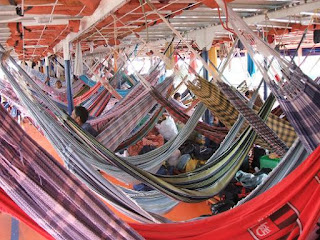
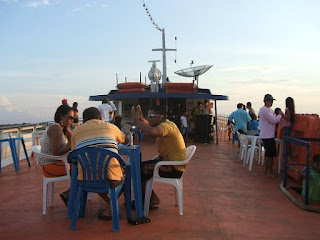
Should I ever decide to write a novel, I will look no further for characters than the NV Dom Migoel, a rusting hunk of lurid orange steel with two decks full of cargo, most of it illicit, a couple of hundred passengers in tightly-packed hammocks, and a bar that opens at 5.30am and closes, well I´m not sure it closes to tell you the truth. One man who would know is Felix Carlos Alberto, known to his friends as `FC´. Like a certain ex-housemate of mine who uses the same nom de guerre, FC is a huge bear of a man, 6ft 5 and close to 300lbs. Like a certain ex-housemate he patronises saunas and massage parlours all across South America, and like a certain ex-housemate he drinks like a fish. When the bell announcing breakfast rang each morning, I would stand on the top deck of the boat and peer out into the redness of the beautiful Amazon dawn, gently sipping my sweet black coffee. FC did likewise, swigging cachassa (the gasoline used to make that deadly Brazilian cocktail, the Caipirinha) from the bottle. He confided in me one night that he had drunk a litre a day for as long as he could remember. Quite how that played with his commanding officers in the Brazilian army is hard to say, but a litre a day barely touched the sides as far as I could see. FC´s four day foray from Tabatinga to Manaus was a mere warm-up, as I write he is back on the river again, drifting down to Belen to meet his mother. He had sufficient supplies of hard liquor to drift right on across the Atlantic and round the Cape I think.

Then there was Antonio, an elderly yet sprightly Jackie Chan lookalike, who in spite, or perhaps because of, his total lack of teeth, managed to be blind drunk for 96 hours straight. He repeatedly asked me to teach him some English, I repeatedly did so, and he repeatedly got even drunker and forgot it had ever happened. By the end of the third day he had forgotten who I was and introduced himself to me all over again. Each time, copious quantities of saliva would scatter from his gaping mouth, showering all within a ten feet radius. Delightful. Slightly less drunk, though just as entertaining in their own tragicomic way, were the young couple, one of whom inhabited the hammock next to mine. She was heartbreakingly beautiful, and seemed scarcely old enough for the two children she ineffectually doted on. He was feckless, drunk, and clearly charming, though unfortunately for him, it seemed his luck had run out a while back. In the process of running out and leaving her, literally, holding the baby, he inadvertently got on the same ferry as her and her quite fearsome mother. Understandably stunned, he tried to reason slowly and clearly, in Spanish, presumably hoping no-one else could overhear or understand. Guess again! She said nothing, but sobbed violently, safe in the knowledge that her mother´s peremptory stares would silence her former love. Hell hath no fury like a mother-in-law scorned.

The only other tourists with me on this Brazilian floating asylum were a nice couple from Austria. Their English is better than my German, so we had a fine old time comparing notes on the resident patients, er passengers, joining us on our voyage of lunacy. For a while I was exceedingly hopeful that the infected blister on Wolfgang´s foot, slowly spreading its pain and discoloured swelling up his ankle and into his calf, would allow me my first ever up close and personal view of gangrene. Disappintingly Wolfgang and his girlfriend Karolina did not share my enthusiasm for such a research project, and promptly disembarked at one of our frequent stops (ostensibly to take on more passengers, in reality to increase the quantity of smuggled goods on board) to have it seen to by a doctor. They too had travelled down through Colombia (loving it as much as I) and are heading north into Venezuela - I suspect we may meet again.

On the subject of smuggling, however, I must report that the lunacy inherent in the peoples of these parts extends as far as officialdom. At 3am on the first night, as expected, we were boarded by Brazilian Customs, who conducted a thorough search of, well, me at least, hoping to find narcotics. My particular officer spoke good Spanish, and was thus able to take full advantage of my vulnerable status as an Englishman abroad. At first I was confused by his impression of a kitten drowning in a pail of water, until with a smirk he muttered the word `Ronaldinho´, and at once I realised he was aping David Seaman being lobbed by the bucktoothed Brazilian boy wonder in the 2002 World Cup.

The comedy didn´t stop there, however, as I was then treated to a hilarious array of jokes and comments about Hugo Chavez and his `Bolivarian Revolution´, which seems to be regarded with even more scorn here in Brazil than in Colombia. But, ladies and gentlemen, now for the grande finale. Drum roll please. Suddenly it all turned serious. As I showed a couple of innocent items (books I think) to the officer, his previously friendly and jovial demeanour disappeared in a flash. He looked at me with a frown, and shouted in Spanish, `MARIJUANA! YOU HAVE MARIJUANA!´ I froze in terror. Of course I didn´t have any Marijuana, but that didn´t matter. I´d read about this kind of thing countless times - everyone has. This was the moment where I was set up for drug smuggling. At best I´d escape with my liberty only after paying an enormous, trip-ending bribe; at worst I was destined to languish, in a rancid Brazilian penitentiary, occasionally remembered by TV news reports met with a cynical response from viewers like myself: `Of course he did it, just look at him´ Clearly he sensed my terror - it can´t have been too difficult after all. Then he emitted a strange, almost bestial noise. A howl of sorts I think. He literally fell onto the floor (we were kneeling at this stage), and began rolling around, convulsing, clutching his sides. I can´t ever recall seeing someone laugh so much in my whole life. `Welcome to Brazil!´were the only words he could muster.

While all in all the four days (is that all it was?) were pleasant and relaxing, the incident with the customs official was by no means the only unpleasantness I had to endure. On Friday evening, while being treated to some freshly caught Amazonian fish as a personal favour from the chef, I inadvertently swallowed a large chunk of bone. Or rather I nearly did. Instead of either sliding down as normal, or choking me to death in a couple of minutes, the offending piece of fish skeleton wedged itself somewhere in the deeper recesses of my throat. And there it stayed for a night and a day. This was slightly disconcerting to say the least. Fearing it might dislodge of its own accord and just kill me in the night, or worse, that anything I ate could at any time become stuck fast against it, with the same result, I took matters into my own hands. At this point, by some happy coincidence, my mood was boosted further by the previously unannounced arrival on board the ship of a Biblical plague of giant Amazonian cockroaches.

There are certainly parts of my journey so far which must sound quite glamourous and exciting, particularly when read from an office cubicle. I can assure you, however, that finding yourself in a darkened cockroach infested bathroom, one hand bracing against the wall while the other conducts a manual inspection of the upper regions of your digestive system is not nearly as fun as it sounds. Attempting to grab a slippery piece of fish bone in between the knuckles of your index and middle fingers is fairly difficult I have to say, even more so when the involuntary gag mechanism which is opening your throat keeps being contradicted by the equally involuntary snapping shut of your mouth to prevent any curious cockroaches from joining the party in my palate. Eventually, 18 hours later, I finally prevailed.

At this point, around 1pm on Saturday afternoon, I was so overwhelmed with relief that I promptly went to the bar and drank six beers in short order to celebrate. And so the last day on board drifted along much like all the others - a joyous combination of hammock, beer, saccharine Brazilian soft rock, sunshine, and the scenery of the greatest river flowing through the greatest forest in the world. And of course the lunatic Brazilians themselves. While my time in this,the fourth largest country on earth, will be limited to scarcely a week, I feel that four days on a riverboat down the Amazon has given me more of an insight into real Brazilians than a much longer trip around the tourist traps of the coast. I'll definitely return to see those one day, though only after I've learned some Portuguese. Imagine the characters I'll meet when I can actually speak...


My Portuguese tutors, Flavia and Ana.


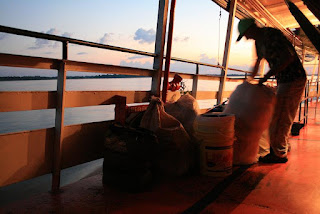
Sunset over some nameless Amazonian port, hundreds of miles from anywhere.


Hammock City.


The Bar!


Cargo.

Monday, July 23, 2007

One Night In Cali

"Pssst, señor, ¿que quieres? Bueno precio..."

Perhaps it's my overactive imagination, perhaps it's the psychotropic antimalarial drugs I'm taking now, or perhaps it's the preponderance of prostitutes, male and female, that proposition taxi passengers at the traffic lights, but I get the sense that Cali is a little bit dodgy. Once the home of Colombia's biggest drug cartel, and still a major base for the narcotics industry, the city also lies on the very edge of FARC-controlled territory. Though usually remaining in rural areas outside of the city, the guerrillas detonated a huge car bomb here in April, an incident that did not fill me with particular excitement as I boarded the plane in Bogota. Upon arrival, a long taxi drive into town ensued. Staring out of the open window into the fetid darkness of the tropical night, there was a certain thrill to be had from the knowledge that somewhere out there lurk earnest peasants in muddy fatigues, carrying AK-47s and copies of "The Communist Manifesto", agitating for the overthrow of liberal capitalist democracy here in Colombia. Just so long as they stay out there and don't start venturing any closer to me, mind, there's a limit to how close I want my thrills.

The city of Cali itself is not beautiful. In many ways nor is Bogota, but the capital has a charming historical district and a striking mountain setting; neither attribute Cali posesses. No matter, however, for despite its preponderence of low-slung American style strip malls, centreless sprawl and slightly eerie emptiness, Cali is widely famed for the beauty of its women and the insanity of its nightlife, both of which had long ago attained near-mythical proportions in my mind at least. I'm not sure why or when I first heard about Cali, but I do know that for a long time I had wanted to go there, my interest piqued by no doubt tall tales of outrageously beautiful gangsters' molls dancing till dawn in sweaty, sexy nightclubs, all underlaid with the definite dark edge that comes from being a city built on white powdery foundations.

In some respects I was slightly disappointed. The nightlife was great, but by Colombian standards lacked just a little something. My strong desire to visit a Caleño Salsatecca to see the locals showing off their salsa skills was tempered with the news that the Juanchito district, home of the Salsateccas, is widely considered off-limits to sane people, let alone gringos, on the grounds of its proximity to some pretty "exciting" slums. I'm not sure if this is true, personally I don't believe it, but for once discretion proved the better part of valour and I elected not to find out. I did, however, head to legendary Cali nightclub, Kukumukara, where I was treated to some quite incredible mountain views. The giant peaks in question were not another extension of the mighty Andes, viewed out of the club's windows however, but were rather contained, more or less anyway, in the skimpy tops of almost every female in the club.

It's quite probable that there are eminent plastic surgeons in Britain, with long and distinguished careers in cosmetic medicine, who have never seen as many silicone breasts as are to be found in a Cali nightclub. In many respects entering Kukumukura was like walking into the pages of Playboy magazine (without the ninety year old pederast in a silk dressing gown in the corner obviously), as a veritable ocean of almost-naked surgically-enhanced flesh lurked at every turn. While some of the women were undeniably attractive, a large number bordered on the grotesque, particularly those who had teamed their artificially-inflated cleavages with similarly pneumatic posteriors. With the temperature in the club rising rapidly, for a time I began to worry about the melting point of silicone, fearing I might suddenly find myself alone, save for numerous steaming piles of molten plastic on the floor. My fears were soon allayed, however, by numerous shots of Aguardiente, the potent local firewater imbibed in vast quantities here. It's nasty stuff, a lot like a kind of sugarfree sambuca, all the more nauseating for being served ice-cold. Still, it's certainly a required ingredient if I am to attempt salsa dancing, which I duly did with little notable success. The other higlight of the evening was certainly one of the bands' live rendition of "La La La La La La Bamba" - to hear a Latin group in a Latin American club actually play that was just too amusing for words.

Anyway, with enough eyefuls of silicone, not to mention Aguardiente, to last a lifetime, I departed Cali early on Friday morning to take in the scenic delights of Colombia's coffee-growing heartlands. About which, more later...

Tuesday, July 10, 2007

Saturday Night In Bogotá

The dancefloor is packed with sweating, gyrating bodies, moving in time to the music. Space is so limited that others are shaking their hips on chairs, tabletops, even the bar; no flat surface is spared. The music is an eclectic mix of salsa, vallenato, reggae, disco, and pop; even gringa Madonna gets an outing, predictably with the ever so slightly Spanish flavoured "La Isla Bonita". All around people are swigging rum, aguardiente (the local aniseed flavoured firewater, effectively a Colombian corruption of sambuca), and whiskey by the bottle. A truly surreal array of actors, or at least I think so, join the revellers in a bewildering selection of costumes. A faun, perhaps Mr Tunnus from C.S. Lewis' classic "The Lion, The Witch, And The Wardrobe" prances across the floor, pausing to sniff various body parts of those he passes. An Indian travelling holy man, or sadhu, sashays around, theatrically begging for alms. A pair of conjoined twins, one black, the other white, one tall and thin, the other short and fat, one gay, the other straight, dance a depraved waltz, all the while making suggestive gestures to women and men alike. Despite it all, the crowd dances doggedly on. It's six thirty in the evening.

Part steak restaurant, part bar, part cavernous nightclub, Andres' Carne de Res is a Colombian institution, recently celebrating its 25th birthday. The staff here are all outrageously attractive; it seems quite feasible that those not fortunate enough to get a job at Andres' become Abercrombie models instead. Most of the customers are of a similar ilk, though the age ranges widely from the three or four year olds taking their first steps on the dancefloor, to the seasoned pros the wrong side of seventy. Like all Colombians, however, they seem to have a natural sense of rhythm. Like all gringos, however, I do not. Luckily no-one seems to notice, or care, the dancefloor being far too full to pay attention to anything except the pounding beats.

Away from the jiving mania on the floor, other Colombians are getting on with the serious business of drinking and eating. In this country it seems that just like in London's more anally exclusive nightspots, liquor is purchased by the bottle rather than the shot. Yet unlike at Boujis, Funky Buddha or Cristal this is not to promote an atmosphere of rarefied exclusivity or conspicuous consumption, instead it seems based on the undeniably economic and logistical advantages of buying in bulk. Rather than spending an aggregate couple of hours fighting to get to the bar each time you go out, most of the evening is spent enjoying the company, the food, and most of all the music. Nowhere I've ever been has had such an atmosphere of universal and unadulterated fun on a night out, except perhaps for Pamplona. Yet this was no once yearly fiesta, but an ordinary Saturday night.

We left Andres around 11 to head for a club in the centre of town. Here too was as similar story. A thousand plus people dancing, dancing, dancing, to everything from Colombian classics to old London favourite "Bomba" ("movimiento sexy..."). There's nothing quite like that feeling of realisation that you're singing along, out of tune of course, to a song whose lyrics you have absolutely no idea of. Except perhaps the feeling of realisation that you're singing along to a song whose lyrics you have absolutely no idea of, in a language you don't speak. I'm sure it was a great look for me.

Having said this, perhaps I'm selling myself short on the language (if not the singing voice). I just managed to convince Aerorepublica (a Colombian airline) that I had indeed bought my flight out of here to the Amazon a couple of months back on the internet, and that they did have the money after all. This morning in class we had a debate about global warming, in which I was quite able to articulate (in Spanish) that, in the immortal words of a fat 8 year old from Colorado, it's all a bunch of tree hugging hippy crap anyway. Not because I believe this obviously, but because it's fun to annoy those who wear hemp, bathe in vegetable oil, and postulate that cows farting is the primary cause of climate change.

Interestingly there is no word in Spanish, or Colombian Spanish anyway, for "tree hugger". Nor is there an equivalent phrase to "political correctness". This is just as well, because some of the conversations that seem to go on around the place are rather incompatible with the concept. In the UK I'm not sure you'd be allowed to discuss the striking physical similarities between aboriginal Australians and monkeys ("micos"), the inherent amusement value of the mentally handicapped ("mongolicos"), or the fact that people in Africa are clearly more stupid than people in South America. Yet I've heard all these viewpoints in the last couple of weeks. Not that Colombians are intolerant, just that they like to laugh, and no subject is considered out of bounds.

On which note, I'm sure any Colombians reading this won't begrudge me a gentle laugh at some of their countrymen. Just like in UK, where the proliferation of little girls named "Chardonnay" and "Champagne" reflects their parents' towering ambitions for their offspring to marry a footballer, Colombia has its own share of aspirationally-monikered juniors, most of them with an Anglo-American theme. Yet aside from the cringeworthy copies ("Leidy" is apparently popular), one example stands head and shoulders above the rest. In the desperately poor, devastingly violent province of Choco, on Colombia's remote northwestern Pacific coast, exposure to the outside world comes mostly courtesy of the strong American military presence in the area to protect the Panama Canal. Still, given the fact that the US "liberated" Panama, formerly a Colombian province, from Bogota's control in 1903, one might think local sentiment would be anti-imperialist. As it turns out. so warm are the feelings of local Colombians towards the Yankees, that many of their offspring have been gifted with American names. Statistically by far the most popular is the initially odd-sounding "Usnavy". Odd that is, until you think about what's printed on the side of "US Navy" vessels.

You really couldn't make this stuff up. On which note, I'm off to do my homework on the Pluperfect tense. I'll write again after my trip to Cartagena for the weekend, where aside from the World Heritage colonial architecture, I'll also hopefully find some Brazilians or Argentinians (ideally both) to watch the final of the Copa America on Sunday. They're billing it as "El Gran Clasico" here, and I for one can't wait. If you need entertainment in the meantime, check out the pictures below, or for a laugh, the following link from the BBC website. Apparently "British forces have denied rumours that they released a plague of ferocious badgers into the Iraqi city of Basra."


No, I didn't drink it all.


Akiel informs me Burberry has now reached Trinidad. I'm not sure about Tobago.


TGI Fridays - with inflatable dolls.


Dance instructor to me - worst job in the world?


Ah no, not quite.


Apart from the flags, Colombia is in no way like France


Saturday, June 30, 2007

La Musica de Colombia

It´s 3am, I´ve been up for 22 hours, and the maid has just been dispatched to buy more beer. Music blares loudly from the radio, the unfamiliar beats strangely infectious, and I join the whole family, dog included, dancing in the front room. No-one mocks my clumsy gringo moves, though I´m soon treated to a bewildering array of lessons. Each time I begin to get a vague idea of what I´m doing, the song (and genre) changes, and suddenly it´s meringue instead of vallenato, ragaton instead of cumbia, Shakira instead of salsa. Shakira at least I have heard of; the family are seemingly unable to believe the likes of "Juanes" haven´t proved a smash in Europe and America. When one of his "hits" does eventually grace us, I have to suppress a fit of the giggles; it´s none other than "Tengo la Camisa Negra" (I have the black shirt), the cheesey Europop anthem that provided so much mirth in Bulgaria a couple of weeks back. No matter: we dance on regardless.

While I knew Colombians had a reputation for partying I can´t say I expected a 4am finish on my first night, having not even left the house. Eventually I staggered to bed "early" with the two youngest members of the clan; the older members of the family continued for another couple of hours, led by Nora, the inexhaustable, incomprehensible "costeña" (from the coast) maid. Despite speaking no English at all (and speaking Spanish with the inpenentrable rapid fire delivery apparently typical of Colombia´s Caribbean natives), Nora is somewhat implausibly something of an aficionada of Anglo culture, at least when it comes to music. Her favourite tape, much to the horror of both her erstwhile employers and this newly arrived gringo, is the Grease soundtrack. She is also something of a Beatles fan - to hear her renditions of such classics as "Twiss an Chout" is almost a unique experience. Only the pure parody of an indigenous Indian playing Simon and Garfunkel´s "Bridge Over Troubled Water" on pan pipes outside the Museo del Oro could possibly come close.

Partying aside, the main reason I chose Colombia to learn Spanish was because I guessed there´d be few other tourists, and thus less "hassle" and less opportunity to speak English. After 24 hours in Bogota I can confirm that I was indeed correct on both counts. Nobody speaks English, there is no hassle whatsoever, and there are so few tourists it seems de rigeur to actually stop and chat with any gringos you pass on the street. Or at least it was yesterday with the one American I chanced to meet while wandering the streets for four or five hours. Bogota seems nice enough, though it probably won´t be rivalling Rio or Capetown in most beautiful city awards any time soon it´s certainly picturesque; with mountains on three sides, the numerous hills provide pretty views at every junction. It also feels a lot safer than might have been expected given its reputation in the mid-90s of being "the most dangerous city in the most dangerous country in the world". That´s right, the streets aren´t paved with powdery white stuff, the currency is pesos not hostages, and the FARC, ELN, M19, AUC et al don´t seem to be engaging in guerilla war in the Plaza Bolivar. Well they weren´t today anyway. Quite ironic really that I arrive in a place with such a fearsome reputation the same day that two giant carbombs narrowly fail to explode in London. I know at least a couple of desperados who could reliably be expected to be lurking in the dark corners of Tiger Tiger at 2am on a Thursday...

Other aspects of Colombia´s reputation don´t appear to be true either, at least in Bogota; the bold claims of "the hottest women in the world" seem laughable, though my cab driver from the airport seemed to concur with Lonely Planet that Medellin or Cali has "las mujeres mas bonitas". "According to Lonely Planet", however, is a dangerous caveat for any sentence; the world´s best-selling guidebook led me to believe (after I elected to come here I must add) that Colombian females were "sexually aggressive", particularly towards travellers. Disappointingly I have seen no hint of this so far, no rapes, no sexual assaults, not even a bit of wolf whistling or groping. If this carries on much longer I might start to develop a complex. Perhaps I need to learn how to dance?