Showing posts with label Photos. Show all posts

Wednesday, October 17, 2007

Beirut: Bombers, Beers, BO18

"Oh my God, it was scary down there man, there were bombs going off, bullets flying, that was some pretty darned crazy shit going down, man!"

The American is sweating, visibly shaken from his daytrip to Baalbek, the fabulous Roman ruins for which Lebanon should, by rights, be famous.

"At Baalbek?", I answer, somewhat incredulous. For while Baalbek does indeed lie deep in the Hizballah heartland of the Bekaa Valley, it's Lebanon's number one tourist attraction, and a most unlikely venue for a show of strength from Hassan Nasrallah's battle-hardened guerillas.

"Yeah man, it was like scary!"
"Today, at Baalbek?"
"Yeah doood, dontcha ya believe me or something?"
"It's not that, it's just I was at Baalbek today. Those were fireworks you heard - for Eid."

I'm afraid to report this conversation really happened, in the foyer of a hostel in Beirut.

Aside from the apparently disappointing (to some) absence of gunfire and shelling, hostile guerilla activity in the Bekaa is all-too evident. The fearsome souvenir salesmen outside the entrance to Baalbek are truly a force to be reckoned with. Perhaps if Israeli PM Ehud Olmert had visited for himself, he might have thought twice about attacking a force clearly so doggedly persistent and determined as Hizballah. I personally escaped with only one Hizballah t-shirt; others were not so lucky. All manner of flags, caps, posters and the like are on offer, all in the tasteful shade of yellow with which the "Party of God" advertises its services to the world. I will certainly never wear that t-shirt outside the house, but personally I think it's a small price to pay for having escaped with my life from the gunfire, shelling, and bombing at Baalbek that day. Erm...

There is a great irony, of course, in an ascetic Shi'ite Muslim sect basing themselves, and their souvenir sales, outside the Temple of Bacchus, famed as the God of wine. The ruins of Baalbek are so spectacular and so exquisitely preserved it's really not difficult to imagine oneself surrounded by concubines, engaged in some Bacchanalian hedonism of the sort so abhorred by the "great" monotheistic religions (what's great about them I'm really not sure, but anyway).

For those whose powers of historical imagination don't extend to drunken orgies in honour of Roman gods, Beirut provides plenty of opportunities for nocturnal enjoyment. In fact I'd venture to say it has the best nightlife in the world. Yes, even better than Bogota. Though much of my weekend in Beirut remains little more than a slightly hazy recollection, a few memories endure. The Lebanese reaction to flaming sambucas was priceless, as was the awed response of a couple of English teachers who currently reside in Irbil, northern Iraq. These people may have endured war, terrorism, invasion and the like, but clearly nothing had prepared them for the sight of two drunk blokes from Leeds setting fire to alcohol in their mouths. From now on I think I shall call my party trick, "Shock and Awe".

Yet while John and I may have surprised the locals with a little sleight of hand and tolerance for flames, Beirut had the last laugh. Around 3am, I strolled back from the bar at BO18, Beirut's most famous nightclub. A fresh breeze wafted across the dancefloor. "Wow, they've turned on the airconditioning" I thought to myself. As I looked around for my friends, I glanced at the ceiling, where much to my surprise I saw a spectacularly realistic projection of stars and clouds. It's difficult to describe my shock when I (finally) realised the roof had been retracted to create a massive open air club, soon to bathe in the warm orange glow of the sun rising over Beirut, beautiful people (and nowhere can people be so beautiful as Lebanon) moving to the beats as a sonic wall of trance music enveloped the club and the streets above.

It was a very long night. As we sat recovering in a cafe on the beautiful Place d'Etoile in Downtown Beirut, surrounded families sitting enjoying the Sunday afternoon sunlight, children playing happily in the pedestrianised square, the British government's advice to avoid "all but essential travel" to Lebanon seemed patently absurd. But wait, what's that? Suddenly a rocket hurtled from the sky into a table at the next restaurant. Two more followed in quick succession. Then more. They were raining down from the sky. Everyone burst out laughing. They were children's toys, made of foam.

Rocket fire in the main square. Just another day in wartorn Lebanon.

Sunday, August 05, 2007

Slow Boat Down The Amazon

`Four days by boat to Manaus? That is not a journey of the modern world, it sounds like something from the nineteenth century.´

Alfredo´s tone was one of surprise and credulous awe rather than scorn, though I´m sure others would question my sanity. If there is something slightly nineteenth century about a four day ferry journey 1000 miles down the greatest river in the world, there is certainly something positively Victorian about taking that journey to get to a place you have no wish to visit, would in fact rather avoid, and which takes you another 800 miles out of your way. So it is that I found myself standing on the docks at Manaus at six this morning, wondering what to do with myself for 14 hours before the overnight bus to Venezuela. Manaus is a city of 2 million people, 1000 miles from anywhere, at the convergence of the Rio Solimoes and its greatest tributary, the mighty Rio Negro. Together the two form what is known as Rio Amazonas, the longest, widest, most voluminous river on the planet. In this vast desolate wilderness of forest the Amazon is the only viable communications link; as such, Manaus is a major international port 1000 miles from the ocean. It has more hookers and `love hotels´ than anywhere I´ve ever been, and everything apart from the whorehouses and this internet cafe is seemingly closed on Sunday. The people are rude and try to rip you off at every turn; it´s hotter than hell. So why am I here? Because, to quote a cliched proverb, `life´s a journey not a destination´; as far as journeys go, few can compare with 96 hours on a floating gin palace down the Amazon.

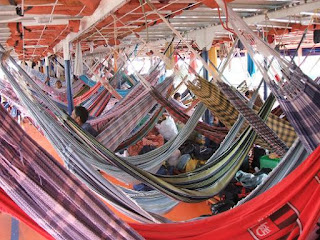
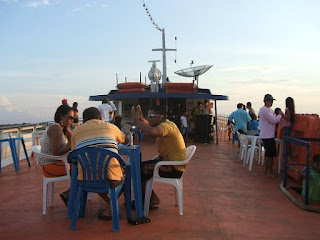
Should I ever decide to write a novel, I will look no further for characters than the NV Dom Migoel, a rusting hunk of lurid orange steel with two decks full of cargo, most of it illicit, a couple of hundred passengers in tightly-packed hammocks, and a bar that opens at 5.30am and closes, well I´m not sure it closes to tell you the truth. One man who would know is Felix Carlos Alberto, known to his friends as `FC´. Like a certain ex-housemate of mine who uses the same nom de guerre, FC is a huge bear of a man, 6ft 5 and close to 300lbs. Like a certain ex-housemate he patronises saunas and massage parlours all across South America, and like a certain ex-housemate he drinks like a fish. When the bell announcing breakfast rang each morning, I would stand on the top deck of the boat and peer out into the redness of the beautiful Amazon dawn, gently sipping my sweet black coffee. FC did likewise, swigging cachassa (the gasoline used to make that deadly Brazilian cocktail, the Caipirinha) from the bottle. He confided in me one night that he had drunk a litre a day for as long as he could remember. Quite how that played with his commanding officers in the Brazilian army is hard to say, but a litre a day barely touched the sides as far as I could see. FC´s four day foray from Tabatinga to Manaus was a mere warm-up, as I write he is back on the river again, drifting down to Belen to meet his mother. He had sufficient supplies of hard liquor to drift right on across the Atlantic and round the Cape I think.

Then there was Antonio, an elderly yet sprightly Jackie Chan lookalike, who in spite, or perhaps because of, his total lack of teeth, managed to be blind drunk for 96 hours straight. He repeatedly asked me to teach him some English, I repeatedly did so, and he repeatedly got even drunker and forgot it had ever happened. By the end of the third day he had forgotten who I was and introduced himself to me all over again. Each time, copious quantities of saliva would scatter from his gaping mouth, showering all within a ten feet radius. Delightful. Slightly less drunk, though just as entertaining in their own tragicomic way, were the young couple, one of whom inhabited the hammock next to mine. She was heartbreakingly beautiful, and seemed scarcely old enough for the two children she ineffectually doted on. He was feckless, drunk, and clearly charming, though unfortunately for him, it seemed his luck had run out a while back. In the process of running out and leaving her, literally, holding the baby, he inadvertently got on the same ferry as her and her quite fearsome mother. Understandably stunned, he tried to reason slowly and clearly, in Spanish, presumably hoping no-one else could overhear or understand. Guess again! She said nothing, but sobbed violently, safe in the knowledge that her mother´s peremptory stares would silence her former love. Hell hath no fury like a mother-in-law scorned.

The only other tourists with me on this Brazilian floating asylum were a nice couple from Austria. Their English is better than my German, so we had a fine old time comparing notes on the resident patients, er passengers, joining us on our voyage of lunacy. For a while I was exceedingly hopeful that the infected blister on Wolfgang´s foot, slowly spreading its pain and discoloured swelling up his ankle and into his calf, would allow me my first ever up close and personal view of gangrene. Disappintingly Wolfgang and his girlfriend Karolina did not share my enthusiasm for such a research project, and promptly disembarked at one of our frequent stops (ostensibly to take on more passengers, in reality to increase the quantity of smuggled goods on board) to have it seen to by a doctor. They too had travelled down through Colombia (loving it as much as I) and are heading north into Venezuela - I suspect we may meet again.

On the subject of smuggling, however, I must report that the lunacy inherent in the peoples of these parts extends as far as officialdom. At 3am on the first night, as expected, we were boarded by Brazilian Customs, who conducted a thorough search of, well, me at least, hoping to find narcotics. My particular officer spoke good Spanish, and was thus able to take full advantage of my vulnerable status as an Englishman abroad. At first I was confused by his impression of a kitten drowning in a pail of water, until with a smirk he muttered the word `Ronaldinho´, and at once I realised he was aping David Seaman being lobbed by the bucktoothed Brazilian boy wonder in the 2002 World Cup.

The comedy didn´t stop there, however, as I was then treated to a hilarious array of jokes and comments about Hugo Chavez and his `Bolivarian Revolution´, which seems to be regarded with even more scorn here in Brazil than in Colombia. But, ladies and gentlemen, now for the grande finale. Drum roll please. Suddenly it all turned serious. As I showed a couple of innocent items (books I think) to the officer, his previously friendly and jovial demeanour disappeared in a flash. He looked at me with a frown, and shouted in Spanish, `MARIJUANA! YOU HAVE MARIJUANA!´ I froze in terror. Of course I didn´t have any Marijuana, but that didn´t matter. I´d read about this kind of thing countless times - everyone has. This was the moment where I was set up for drug smuggling. At best I´d escape with my liberty only after paying an enormous, trip-ending bribe; at worst I was destined to languish, in a rancid Brazilian penitentiary, occasionally remembered by TV news reports met with a cynical response from viewers like myself: `Of course he did it, just look at him´ Clearly he sensed my terror - it can´t have been too difficult after all. Then he emitted a strange, almost bestial noise. A howl of sorts I think. He literally fell onto the floor (we were kneeling at this stage), and began rolling around, convulsing, clutching his sides. I can´t ever recall seeing someone laugh so much in my whole life. `Welcome to Brazil!´were the only words he could muster.

While all in all the four days (is that all it was?) were pleasant and relaxing, the incident with the customs official was by no means the only unpleasantness I had to endure. On Friday evening, while being treated to some freshly caught Amazonian fish as a personal favour from the chef, I inadvertently swallowed a large chunk of bone. Or rather I nearly did. Instead of either sliding down as normal, or choking me to death in a couple of minutes, the offending piece of fish skeleton wedged itself somewhere in the deeper recesses of my throat. And there it stayed for a night and a day. This was slightly disconcerting to say the least. Fearing it might dislodge of its own accord and just kill me in the night, or worse, that anything I ate could at any time become stuck fast against it, with the same result, I took matters into my own hands. At this point, by some happy coincidence, my mood was boosted further by the previously unannounced arrival on board the ship of a Biblical plague of giant Amazonian cockroaches.

There are certainly parts of my journey so far which must sound quite glamourous and exciting, particularly when read from an office cubicle. I can assure you, however, that finding yourself in a darkened cockroach infested bathroom, one hand bracing against the wall while the other conducts a manual inspection of the upper regions of your digestive system is not nearly as fun as it sounds. Attempting to grab a slippery piece of fish bone in between the knuckles of your index and middle fingers is fairly difficult I have to say, even more so when the involuntary gag mechanism which is opening your throat keeps being contradicted by the equally involuntary snapping shut of your mouth to prevent any curious cockroaches from joining the party in my palate. Eventually, 18 hours later, I finally prevailed.

At this point, around 1pm on Saturday afternoon, I was so overwhelmed with relief that I promptly went to the bar and drank six beers in short order to celebrate. And so the last day on board drifted along much like all the others - a joyous combination of hammock, beer, saccharine Brazilian soft rock, sunshine, and the scenery of the greatest river flowing through the greatest forest in the world. And of course the lunatic Brazilians themselves. While my time in this,the fourth largest country on earth, will be limited to scarcely a week, I feel that four days on a riverboat down the Amazon has given me more of an insight into real Brazilians than a much longer trip around the tourist traps of the coast. I'll definitely return to see those one day, though only after I've learned some Portuguese. Imagine the characters I'll meet when I can actually speak...


My Portuguese tutors, Flavia and Ana.


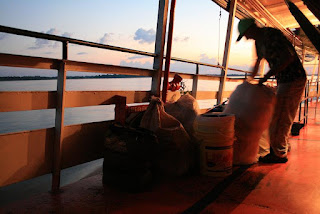
Sunset over some nameless Amazonian port, hundreds of miles from anywhere.


Hammock City.


The Bar!


Cargo.

Into The Jungle

I sit in the bow of a small wooden canoe in a brown creek, holding a primitive cane fishing pole. Monkeys shriek in the trees on either side of the river, pink dolphins frolic in the murky waters ahead, and pairs of colourful macaws fly overhead. I feel the tension grip my line, and yank hard. I pull out another fearsome red bellied piranha, my eighteenth such catch in just over an hour. This is the Amazon alright.

I had caught my first glimpse of the great rainforest from the plane. About half an hour after leaving Bogota, a casual glance out of the plane window revealed the terrain below had dramatically shifted from the usual, well, English-looking, green fields and rolling hills of the Colombia I've come to know, to something entirely different altogether. As far as the eye could see, all was dark. For a second I was flummoxed, thinking the vast featureless expanse below could only be ocean, an impossibility on this landlocked internal flight to the south. Then I realised. The rolling sea below wasn't water, but trees. This wasn't the Pacific, it was the Amazon.

There is something definitely unromantic about air travel; namely the convenience of boarding in one hermetically sealed featureless generic airport and arriving in another equally sterile characterless concrete vault, without any conception of the journey, of the gradual transition from one environment to another. Yet the visual perspective from a plane cannot be beaten. Only from the air can the sheer scale of the Amazon even begin to be comprehended. According to the stats on Wikipedia (not a source I quote with a great deal of confidence), the forest itself occupies over 5.5 million square miles, making it larger than every country on earth except Russia. Colombia's small portion of the rainforest alone is bigger than Germany or California, and it really shows from the air.

Such scale is awe-inspiring, frightening in a way, particularly when one is flying over it. Assuming you didn't succumb to the heat, the biting insects, the deadly snakes, spiders, scorpions or big cats, one could walk for thousands of miles through the forest and never come across anything even closely resembling civilisation. Whether or not such a hike would encounter humans of a lightly less than civilised disposition is unclear; the forest is so vast and unexplored that anthropologists believe there are many "uncontacted" tribes still waiting innocently for the modern world to blunder in and destroy them. I find this prospect quite staggering in its implications. Consider for a moment the possibility, no, the certainty that there are groups of people, more or less like you or I, wandering around in the rainforest totally oblivious to the rest of the world. They have never encountered electricity, machines, in all probability, the wheel. They are unaware of the whole course of human history beyond the narrow confines of their own society, unaware of the existence of a geography beyond their own little world, totally unaware of other languages and cultures. Yes, who knows how many Americans may be wandering lost in the forest?

Incidentally, I do not mention the fear engendered by flying over such a vast expanse of wilderness out of mere curiosity; in my final Spanish class I had been priviliged enough to read a compelling article in Colombia´s premier daily newspaper, El Tiempo, about the truly appalling safety record of Aerorepublica, the country´s second biggest airline, who in recent months have had real problems successfully landing on runways. As Aerorepublica flight 7481 hurtled out of the sky into what seemed like yet more undisturbed green jungle, I can´t say I didn´t think about this questionable record for just a second. While I´m always keen for a spot of off the beaten track adventure, the prospect of hacking a new path through a few hundred miles of virgin rainforest did not fill me with much enthusiasm.

Bearing this is mind, fast forward 48 hours and picture the scene: `Jimmy´, our indigenous guide hacks at the undergrowth with his machete, clearing a path through the jungle. I´m dripping with sweat, and more than a little terrified as my eyes scan the path ahead for all manner of savage beast: poisonous vipers, 30 foot anacondas, giant tarantulas, jaguars, any or all could set upon me at any moment. To make matters worse, I´m wearing only a pair of slightly faded sky blue Tommy Hilfiger boxer shorts and an eccentric Indiana Jones style hat. Quite how I came to find myself wandering through a remote stretch of the Brazilian Amazon rainforest clad only in my pants I´m really not sure. I can only say that at the time, having just finished bathing in a delightfully cool forest stream, it seemed logical to allow myself a chance to dry off before putting my trousers back on. Now, however, as insects, birds and who knows what else hiss, hum and shriek all around me, I´m beginning to reconsider. The Amazon is no place for a man without trousers.

All in all I spent the best part of four days exploring the remote regions of the Rio Javari on the border between Peru and Brazil, and an idyllic four days it was too. Fishing for piranhas, catching caimans (an Amazonian species of crocodile) bare handed, forest walks, scaling the canopy to a platform 130 feet up; I did many unforgettable things and saw many incredible creatures. Yet for me at least, the most amazing sensation of all was the feeling of being so deep in the wilderness. Six hours by boat from Leticia, itself 500 miles from the nearest road, this really was the back of beyond. As I lay in bed at night, nothing but a mosquito net between me and the jungle, listening to the chorus of howls, wails and clicks emanating from the trees and admiring the blindingly bright carpet of stars above, I really felt a very long long way from anywhere. In the age of mobile phones, blackberries, and constant instantaneous communication, that is a rare sensation indeed, and a privilege I feel immensely fortunate to have enjoyed.

I must remember to keep my trousers on next time.


"Chantelle, je t'aime"


"That parrot's dead!" "No he's not, he's just resting!"


Ok, this one is definitely alive.


Yes, that's me, and yes, that's a crocodile.


That's not me, but it is a deadly red-bellied piranha.


Sunrise over the Amazon.

Adios a Colombia

`Hola, como esta? Soy de Inglaterra, y voy a Brasil´
`Ola. Snsh veyt minhuto bem vindo htyu ererh bassaborte´
`Er, Que?´

What the fuck? At this point I realise the utter stupidity of spending a month intensively learning Spanish only to immediately head to Brazil. Portuguese is a truly ridiculous language, of which I understand not a word. The really irritating thing, however, is that it´s sufficiently similar to Spanish that they can understand me perfectly, thus giving the illusion of ease, an illusion that is immediately shattered as soon as they commence their seemingly part Russian, part French, part Latin response, all of which with the kind of accent that should really necessitate some intensive enunciation sessions with a speech therapist.

Still, linguistic nightmares aside, I managed to negotiate my way into Brazil successfully, but such is the way with formalities here in the `Three Borders´region of the Amazon, where Brazil, Colombia and Peru converge on a narrow stretch of river, I took my shiny Brazilian stamp and immediately returned to Colombia. There is effectively no border here, as I discovered last night when I inadvertently wandered into Brazil. Despite the proximity and de facto merger of Leticia and Tabatinga into one united conurbation, the differences between the two towns are striking. Where Tabatinga is dirty, rundown and chaotic, characteristically a frontier town, Colombian Leticia is a sprightly and prosperous place. On the face of it, this fact should be slightly surprising. 500 miles from the nearest road, reachable only by riverboat and plane, aside from a nascent tourist industry there seems little here to support any kind of town, let alone one so obviously prosperous. The economic miracle of Adam Smith´s famous `Invisible Hand´has never seemed so enigmatically well-hidden as here.

The answer to this conundrum, of course, is simple. Cocaine. An oasis of semi-civilsation in the midst of vast swathes of impenetrable jungle resolutely controlled by the FARC, with virtually unpatrolled borders between the coca-leave producing Peru and the cocaine-consuming Brazil, Leticia is a prime spot on the trade route for Colombia´s number one export product. In the interests of idle curiosity I asked a taxi driver a little about the industry in these parts; he was only too happy to respond. (By way of an aside, there is something infinitely rock and roll about sitting on the back of a motorbike discussing the narcotics industry in Spanish as you roar around the streets of a Colombian border town trying to find th best exchange rate from the street money changers.) A kilogram of pure cocaine apparently costs US$1,200 in Leticia, which is quite staggeringly cheap; according to my source (on this particular topic, I think a guy who drives a motorbike in Leticia is probably quite reliable), that same kilo, once cut with various potions and powders, will make 3 kilos in the west, with a street value of around US$300,000. Suddenly it all makes a little more sense. No wonder Pablo Escobar was in the top ten of the Forbes Global Rich List for over a decade. Still, he did die in a hail of bullets in a Medellin sidestreet, so perhaps the life of an international druglord isn´t all gravy...

My brief investigation into Leticia´s import-export industry over, I head to the port to catch a boat down the Rio Javari to a remote ecolodge in Brazil. Or perhaps in Peru? As I´m already officially in Brazil, I avoid the passport formalities of my three fellow explorers, two affable Catalonians and a typically chirpy Colombian, yet follow them to Santa Rosa, Peru anyway. This is my third country in half an hour, which is in itself a little disconcerting. It feels bad to be back in Peru, a country to which, despite its inestimable natural and archaological wonders (everyone should see Machu Picchu once), I took a strong dislike on my last visit in 2002. Santa Rosa is no different. Visibly much poorer than Tabatinga or Leticia, Santa Rosa is little more than wooden shacks rising out of the mud. With typical Peruvian efficiency we find the Immigration Office closed, the presiding bureaucrat at lunch, where we join him in a quite appalling restaurant, replete with various indigenous Amazonian animals caged in heartbreaking squalor. Combined with the excruciating noise emanating from the live band, this makes for a thoroughly unpleasant half hour; finally the necessary formalities finalised, we are free to go. I am officially in Brazil, while Luis, Alfredo and Francesco are officially in Peru. All of us are actually in Colombia, as we stop once more to secure vital supplies - a crate of Aguila beer - for the six hour journey into Brazil. Confused yet? I am...

But so it is that with a slightly heavy heart I say goodbye to Colombia, a country I can honestly say I´ve come to love over the last month. The people, the culture, the scenery; what a fantastic place. I will certainly return one day, hopefully soon, and that´s not something I can say about too many places. You´ll shortly find below a selection of photographic mementos of some of my Colombian amigos and amigas - I hope to see them again one day soon. Perhaps in Nora´s case, on MTV. But for now I move onto new adventures. The Amazon!


Akiel, from Trinidad (and Tobago), and Miguel, my anarchist Spanish teacher


Samuel, the craziest dog in Colombia


Akiel and Paula Andrea. She´s quite normal, for a Colombian


Nora. Like Shakira she´s from Barranquilla. Like Shakira she´s a singer. Unlike Shakira, seeing her emerge from the bathroom in just her lacy underwear was not one of the all time highlights of my time on earth.

Monday, July 23, 2007

The Starbucks Express


The small bus stopped suddenly. My heart froze. Half or dozen or so men in exceedingly dirty clothes and muddy wellington boots, carrying foot-long machetes, were boarding. The first one, his face moustachioed and weather-beaten, and his hands calloused from heavy labour (burying bodies? I mused to myself), paused slightly when he saw me. Then a smile lit up his face as he greeted me: "Buenas tardes señor, ¿como está?".

Someone in Bogota told me that the way to spot FARC members is their penchant for wearing wellies at all times, even in towns on sunny days. If this is correct, Colombia's woes are much greater than I realised, for in the coffee region everyone wears wellies. I only hope the army can hold out against the rampant hordes of welly-wearing Marxists until the weekend when I say "adios" to Colombia. Happily for my bus journey, I think this means of identifying the rebels may lack something in the way of accuracy, as these particular rubber boot aficionados seemed to be employed by the coffee industry rather than the militant revolutionary forces of the international proletariat. Coffee is big business here, and it's taken very seriously indeed by the Colombians, nowhere more so than at the Parque Nacional de Cafe, Colombia's answer to Disneyland. Actually, that's not quite true; no-one could really describe a theme park devoted to coffee beans as serious. Regardless of the tone, it's a very informative place, which teaches the visitor all he or she might want to know (and a good deal more besides) about the whole bean to cup process.

Yet aside from the coffee itself, the main reason to visit the so-called "Zona Cafeteria" is the scenery. Set in lush mountains to the west of Bogotá, quaint little towns and spectacular fincas dot the verdant hillsides. I spent the Independence Day weekend in one such pueblo, Salento, hiking in the countryside during the day and joining in the local July 20th festivities by night. These festivities mostly seemed to consist of eating trout (a local delicacy), drinking aguardiente, and high speed synchronised dancing. One fellow traveller (from Belfast I believe, though I didn't meet him myself) apparently over-indulged in the local culture to such an extent that he was taken into protective custody by the police, who feared the consequences of the local menfolk catching up with the paralytic Ulsterman who had been touching their women. After a 1am call from the cops, the owner of the local traveller's hostal, an affable British chap called Tim, headed down to the station to interpret. After much violence and swearing, it was decided to allow the Irish miscreant to remain in a cell for the rest of the evening; upon his release the next morning, the police insisted he sign a statement affirming he had not been mistreated. Something tells me a Colombian in a similar position in UK might not have been granted such hospitality. What's the Spanish for "fell down the stairs"?

Unlike the unfortunate Ulsterman, however, I managed to restrain myself for once, having to rise early for a trek. Six hours of hiking through a nature reserve in the cloud forest certainly seemed preferrable to a hangover and a story about a Colombian police cell, especially when it afforded the opportunity to see the unique wax palm trees that dot the area. Though certainly aesthetically-pleasing, the wax palm (see photos below) is seemingly a particularly pointless species, growing a ludicrously long thin trunk before sprouting normal palm leaves about 60 feet up in the air. Any time you meet an evangelical Christians who attempts to debunk the theory of evolution with reference to so-called "intelligent design", please direct him to the Valle de Cocora in central Colombia, where a cursory inspection of the Peter Crouch of palm trees will provide him with ample evidence that "intelligent design" is a totally fallacious concept. But more about God later.

After beginning my weekend with a flight to Cali, I planned to return to Bogotá via road, both on grounds of expense (because of the distances involved internal flights in Colombia are not overly cheap) and because I dimly recalled reading some strikingly congratulatory comments about the spectacular scenery on that road in Paul Theroux's "The Old Patagonian Express". Indeed, after travelling by train and bus from Boston to Bogotá, Theroux was keen to suggest this particular road passed through some of the most spectacular scenery in the whole of the Americas. Of course when reading such glowing tributes from the comfort of one's armchair, sipping a mug of cocoa, the true implications of words such as "spectacular" are often hidden. Five years ago I crossed the Andes on a bus, in Peru, and after a 20 hour journey so nerve-shatteringly awful I almost turned to religion, I vowed never to do it again. 18 hours of figuratively shitting myself as we barely negotiated hairpin bends on narrow pot-holed roads with vertiginous drops just inches from the outside wheels of the bus were followed by two hours of actually shitting myself after consuming some toxic corn-based snack at a roadside truck stop. "NEVER AGAIN" I promised myself.

In light of this experience, quite how I found myself sitting in the front seat ("for best views" the driver told me in Spanish, without a trace of irony) of a 17 seater minibus snaking its way at high speed around cliff top roads in thick cloud and pouring rain, I'm not sure. Unlike Peruvians, however, Colombians seem to take a slightly more positive view of the concept of road safety, and do therefore have such measures as seatbelts and paved highways in place. Not that a seatbelt would be a great deal of use were the bus to plunge 7,000 feet over the side of a cliff, but I guess it's the thought that counts. In fact, so seriously do the bus companies take the issue of safety, that each of their ticket booths features a highly tasteful scorecard of crashes, injuries and deaths on each route in the last 6 months. I didn't enquire about the stats for a longer timescale; some things are better left unsaid.

In addition to all these admirable measures, it seems Colombian buses are also equipped with a giant digital speedometer, allowing everyone on board to monitor velocity at all times. Should the driver get a little too carried away and exceed the 80km per hour legal limit for his rattling jalopy, a noxious alarm sounds until the speed is reduced. While surely well-intentioned, I found this invention to be totally and utterly terrifying. Who really needs to know that the bus is approaching a 90 degree switchback on the wrong side of the road at 72kph? If you ask me it merely panders to the vanity of the driver's constant Juan Pablo Montoya impressions. And while we're on the subject of Colombia's number one racing driver, I don't ever recall him finding himself confronted with a 15 ton articulated lorry as he takes the racing line through the apex of a blind bend, as happened to our noble chauffeur innumerable times on Sunday. Nor does Señor Montoya have to juggle mobile phones, two-way radios, gear sticks, steering wheels and cholesterol-rich snacks as he tears around the streets of The Principality in his state of the art racing machine.

Yet in truth, none of this really mattered, for we had God on our side all along. As we pulled out of the Terminal de Autobuses in Armenia, just before donning his imaginary flame retardant suit, leather driving gloves and crash helmet, our intrepid driver solemnly crossed himself and offered a couple of silent prayers to the big man upstairs. Many of the passengers followed suit. An hour later, as we deftly avoided the still-smoking scene of a (very) recent head-on collision between a Renault Twingo and a twenty ton truck by sneering at the oncoming traffic and veering casually into the opposite lane at 63kph, I too was on my knees, offering myself in supplication to God, Jahweh, Allah, Buddha, Robbie Fowler, and any other deity I could think of.

Still, on the plus side, our journey to Ibagué was completed in half the official four hour allotment; not an outcome that would be repeated on the second leg of the trip back to Bogotá. In fact, at times on that hellish six hour drive, I was almost overcome with nostalgia for the suicidal tendencies of the earlier driver, particularly when the giant neon speedo dipped below 10kph for the umpteenth time. Night buses in Colombia hold their own particular terrors; Lonely Planet is particularly vehement in its advice to avoid them, and legion are the tales of unwary travellers who lose all their belongings when a nice man with a gun flags down and boards their bus at 2am. Yet such were the crowds of revellers heading home after the Independence Day weekend that waiting for a journey in darkness was the only option. "Still, at least you can't see the cliffs at night", I thought to myself as we waited to depart; fervently hoping for a driver without the quivering moustache and devilish glint in the eye that so often signifies lunacy in South America. I needn't have worried; regardless of the psychiatric state of the driver, our bus' engine was so weak that speed was an impossible dream, and the Colombian army had so many units on highway security patrol over the weekend it was difficult to go 50 yards without seeing a listless pimply youth with a machine gun. What good these soldiers of boredom would actually be in the event of an actual firefight with the FARC or some would-be bandits I'm not sure, but I suppose they act as a deterrent.

Yet there were other horrors to contend with, not least the driver's grim obsession with the spirit-crushingly irritating Vallenato music omnipresent in much of Colombia. There are many ways to kill a man with his own accordion, and I thought of them all as the terrible folk tunes played grimly on and on. At one stage the radio station was briefly changed; my relief was short-lived, however, as a Spanish language version of Robbie Williams cigarette-lighters-in-the-air anthem "Angels" replaced the incessant whining of the accordions. "Angeles" (sample lyric: "voy a amar a los ángeles...") was even more awful in reality than you could ever possibly imagine, and was very nearly the final straw. Yet somehow I survived, finally rolling into Bogotá at 2am, over twelve hours after leaving Salento. For what it's worth, the scenery on the road WAS incredible, at least the small sections I could see through my fingers, and unlike in Peru I managed not to soil myself at any point of the journey, which was a distinct bonus as I'm sure my fellow passengers would agree.

One more week of class in Bogotá, then it's off to the Amazon on Saturday. Sadly I won't be taking the bus - being 500 miles from the nearest road, Leticia is inaccessible by any means except boat or plane - though a couple of weeks from now I will be facing the delightful prospect of a 16 hour journey on Brazil's Trans-Amazonian highway. While there are no mountains to contend with there, I'm sure ample excitement will be provided by the unavoidable traverse of the Yanomami Indigenous Reserve. In case you're not aware, many anthropologists regard the Yanomami as the most violent people on the planet (yes, they're even more violent than Glaswegians). When the road was built in the early 90s, the Brazilian army had to massacre hundreds of Yanomamis irate at the intrusion of the white (well, light brown) man into their territory. Armed only with poison arrows and blow darts, the locals stood little chance of victory, though they did cause a substantial number of deaths. In the circumstances it's probably best not to run into them on the road; to be on the safe side the highway is closed between dusk and dawn and all stoppages are expressly prohibited. I'm not sure what happens in the event of a breakdown...


A rare Colombian Wax Palm Tree


Liverpool and England striker Peter Crouch


Ludicrously tall Wax Palms in the Valle de Cocora


Hummingbird silhouetted against the cloud forest


Hummingbird on a sugar feeder. Mmmm....sugar...


Coffee!


While I understood most of the coffee-making process, I still can't work out where these peanuts come into the equation. What's that? They're beans? What kind of beans?


In Latin America this sign means "don't catch the birds". In Spain, however, it's a more serious offence. Quite how you'd fuck a parrot I don't know...

Monday, July 16, 2007

Love In The Time Of Cholera

Bougainvillea fringed wooden balconies overhang narrow cobbled streets lined with brightly painted houses. Horse drawn carts clatter across the stones as laconic, dark skinned men sit on the dusty pavements swigging beer from the bottle and playing dominoes. Music wafts into the night air on the warm ocean breezes, and the most beautiful girls in the world gently sway their hips in doorways, while their grandparents rock rhymthically in their chairs.

As I've already written, the Lonely Planet guidebook describes Cartagena as "a fairy tale city of romance, legends, and sheer beauty" and "the most spectacular colonial city on the continent". I can't vouch for the second claim, as my experience of South America is thus far limited to Peru, Bolivia, and Colombia, but I can certainly confirm that Cartagena is indeed a very special place. An hour and a half flying time from Bogota, and Cartagena feels every bit of it. The palm trees lining the runway, the blast of hot air when the door opens, the pools of rainwater in the streets from the customary afternoon storm, even the noticeably darker inhabitants; make no mistake about it, this is the Caribbean.

Yet the difference between Cartagena and Bogota is more than just geographic - there's a distinct time shift between the Andes and the coast. Everything is much slower here, on island time as it were. There's another, more subtle, time difference though; in many respects Cartagena lies in a different century from the capital. While it has the same accoutrements of modern life as any big city in Latin America - internet cafes, cash machines, mobile phones - wandering the old town here could quite easily convince you you'd stepped into a timewarp. Put it this way, Cartagena is the only place I've ever been where the horse drawn carts seem plausibly authentic rather than tacky and artificial.

There is certainly a fairytale quality to all this: the gingerbread houses, the horsedrawn carriages, the walls defending the city from pirates, and Cartagena's history rivals any yarn from a children's storybook. Founded in 1533 on the site of an old Carib Indian settlement, Cartagena quickly grew into the most important port in Spanish America. Almost all the incalcuable treasure - gold, silver, emeralds and the like - extracted from South America's soil was shipped through Cartagena back to Spain. To put the quantities into some kind of perspective, the mines of a single Bolivian town, San Luis Potosi, reputedly yielded sufficient riches to build a solid silver bridge, 6 feet wide, all the way back to Madrid. Cartagena's spectacular architecture was one result of all this commerce; the constant scourge of piracy was another. The most famous of these buccaneers (you may wish to look away now if your version of history was taught in a British school), Sir Francis Drake, held the whole city to ransom in a long and bloody siege in 1586, graciously agreeing not to raze it to the ground upon receipt of ten million pesos. In response to this and numerous other assaults by seamen flying the skull and crossbones, the Spanish colonialiasts ringed Cartagena first with a series of forts, and later with the city walls which still stand today. Standing on the ramparts watching the sun sink slowly into the Caribbean, it's not at all difficult to imagine a pirate galleon sneaking over the horizon...

In addition to its ancient myths and legends, Cartagena was more recently the setting for Gabriel Garcia Marquez´s 1985 novel "Love In The Time Of Cholera", a fantastical fairytale loosely based on his own parents' courtship along Colombia's Caribbean coast. The book, published after his Nobel Prize for Literature yet arguably his best, will soon receive a great deal more publicity when the Hollywood adaptation hits screens across the globe later this year. Directed by Mike Newell, of "Four Weddings and a Funeral" fame, with a screenplay by 'Gabo' himself, and starring Javier Bardem, Benjamin Bratt, and Catalina Sandino Moreno, the movie promises to put Cartagena even more firmly on the tourist map as it was filmed on location in the city.

The story gets its name from the fearsome cholera epidemic which forms the backdrop to a hilariously absurd love story. In an amusingly (though not for me) apt parallel to the novel, my own whirlwind romance with Cartagena was also painted with a similar backdrop on the canvas as I battled a mysterious stomach ailment. While it obviously wasn't cholera, after some careful reading of the Health section of the Lonely planet (I strongly recommend you never try this), I am however sure that it was one (or all) of Typhoid, Amoebic Dysentry, or Hepatitis A. Still, luckily for me, Colombia, as you all well know, is renowned as the "drug capital of the world", and as a result the regulations regarding prescpriptions are somewhat lax. It seems that in place of the highly secure system in place in Britain (where any totally illegible scribble on something vaguely approximating a green piece of paper with a doctor's name will suffice), merely going up to the counter and saying "Amoxycillin, por favor" will produce favourable results. Whether such leniency extends higher up the drug potency chain is unclear. "Methadone por favor"? Hmmm... Anyway, as a result of my battle with a species of bacteria hitherto unknown to medical science, I ate two meals between last Wednesday and yesterday (Monday), subsisting almost entirely on a diet of gatorade and immodium. Personally I think it could be the new Atkins. Fortunately my initial tentative foray into the field of experimental pharmacology seems to have had some success, and I'm now back eating again. I may limit my intake of the ubiquitos Colombian "frijoles" (beans) for a while, however.

I conclude with an update on the "Usnavy" anecdote from my previous update. It seems another popular name in the Choco is taken from the currency. As the locals astutely inferred, any man important enough to have his picture on a dollar bill must be worth naming your offspring after. Unfortunately, however, that was the full extent of the intelligence on display in Choco province, hence a large number of children now run around the streets known as "Onedollar". To be fair, I'm not sure "George Washington" would be much better, but...

On that note, I'm off to conclude my homework - a 20 minute presentation (in Spanish of course) on "the history of guerillas in Colombia". I'll write again after the weekend, when I should be able to report on Cali, the self-styled salsa capital of the world, and also the Coffee Region. Pictures of Cartagena are below.

"Nobody expects the Spanish Inquisition." Except perhaps here, at the Palacio de la Inquisicion.


This being Colombia, dancing in the streets is mandatory.


Like Freddie Mercury, Fernando Botero likes Fat Bottomed Girls.


"¡Dios mio! It's the damned English again!"

Tuesday, July 03, 2007

Goooooooooaaaaaaaaal Coooloooombiiiiiiiaaaaa!


We´ve all heard clips of Latin American football commentators screaming their trademark word at outrageous volume for a seemingly impossible length of time - for many people it´s probably the one thing they associate above all others with the continent. Last night, for the first time, it actually meant something more than a moment´s mirth at the commentator´s expense. Last night, for ten glorious minutes, Colombia led the mighty Argentina in their second game in Copa America´s Group C, thanks to a smart backheel from Edison Perea. For just a moment, the country dared contemplate victory against the hot favourites for the competition, and with it some measure of pennance for their shocking 5-0 defeat to unfancied Paraguay in the opener. In the event, Argentina triumphed with ease, the 4-2 scoreline flattering my adopted team somewhat. It was something of a Pyrrhic victory for Argentina, however. Chelsea misfit and Argentina star Hernan Crespo, now shorn of his trademark outrageous greasy locks, converted the crucial penalty, but in the process proved he is still as idiotic as ever, seriously injuring himself running to the crowd to celebrate.

Unlike Crespo, however, one man who has definitely not lost his defining outrageous barnet is Colombian football icon and scourge of hairdressers everywhere, Carlos Valderrama. His gurning visage and ludicrous shock of orange hair shines out from billboards across Bogota in his new role as marketing champion for a popular brand of potato chips. Personally I daren´t go near the things for fear of waking up with an Einstein-like mop on my head, but the locals seem to like them. If you ask me he´s no Gary Lineker though.

Aside from joining in the all too familiar experience of national mourning that follows the highly predictable exit from major competition of a country´s football team, I´ve also found time to continue my exploration of Colombia´s capital, and I must say, I think I like it here. Somewhat surprisingly to many of you I´m sure, Bogota is in fact a very modern city, which in parts more resembles Mayfair, Miami or Manhattan than the grimy crime-ridden shanties of popular imagination. As I sat sinking "tintos" - the strong, sweet, black coffee on which the nation seems to run - outside a Zona Rosa cafe yesterday afternoon, watching hip, good-looking Bogatanos wander in and out of Versace, Dior, and Diesel boutiques, it occurred to me that I could really have been in any sizeable city in Europea, Australia or America. Yet 24 hours previously I had joined thousands of devout Catholics ascending Cerro de Montserrate, the mountain which dominates eastern Bogota, on their weekly pilgramage to an allegedly divinely empowered Christ statue. My own motivation was more temporal than spiritual - Montserrate provides spectacular vistas across the entire Sabana de Bogota - but it was fascinating to see the faithful go about their business.

Catholicism is at the heart of Latin America´s contradictions, and Bogota is no exception. Prior to my Sunday afternoon pilgrimage, I had inadvertently engaged in a controversial political protest. It was only after the tenth or eleventh volunteer stopped to ask for my participation in their survey that I realised the precise focus of the proceedings, however. The conversation that follows is in Spanish, though it doesn´t require any great grasp of the language to understand.

- "La primera pregunta señor. ¿Usted es - 1) gay, 2) lesbiana, 3) bisexuelo, o 4) transgenero?".
- "Perdon, er, no soy gay"
- "¿No es gay?!"
- "No"
- "Verdad, ¿no es gay? ¿No?"
- "Grrr......"

Still, I guess we´ve cleared up the apparently inexplicable ability of the supposedly nymphomaniac local females to keep their hands off me. It later transpired this survey was part of a much larger rally - this I realised when I stumbled obliviously into a mass protest in the Plaza de Bolivar. In the shadow of the ubiquitous statue of this continent´s great Liberator, an obviously ennervated series of speakers raged against the improprieties inflicted on them by the "Fascist" regime of President Alvaro Uribe. And gay rights are not the only area of Colombian life in which the dominating spectre of the Catholic church holds sway - like much of the continent abortion is illegal here. I for one find it somewhat difficult to reconcile the hedonistic lifestyle, highly provocative dress sense, and all the trappings of modern consumption culture so evident here, with the highly conservative religious underpinnings of being a Catholic nation. Perhaps Colombians do too?

In an effort to answer such questions, or at least to engage with the locals on a more meaningful level than pointing and shouting at items in shops, I today began an intensive Spanish course. When I booked the course a couple of months back I´m not at all sure I quite realised what "intensive" meant. Anyway, five hours of one to one tuition and an hour of conversation practise at lunch later, I am now struggling to stay awake. Ordinarily this wouldn´t be such a problem, however, I have significant amounts of homework to complete by 8.30am. Think of me tomorrow - while you´re swigging Starbucks, trolling the internet and sending personal e-mails by the dozen, I´ll be slaving away in a cold Colombian classroom, struggling with the rudiments of Spanish grammar. I know where I´d rather be...

Please find below a few photos from my initial explorations of the city.


Bogota - bigger than London. Less terrorism too.


La Plaza de Bolivar - you know you're in South America


Colonial architecture in La Candalaria district


Gold "Jaguar Mask" in Museo del Oro


Carlos Valderrama says: "eat Margaritas for curly hair"


For some reason they call it cloud forest


Room with a view - Cerro de Monserrate, Bogota